
Biogenesis

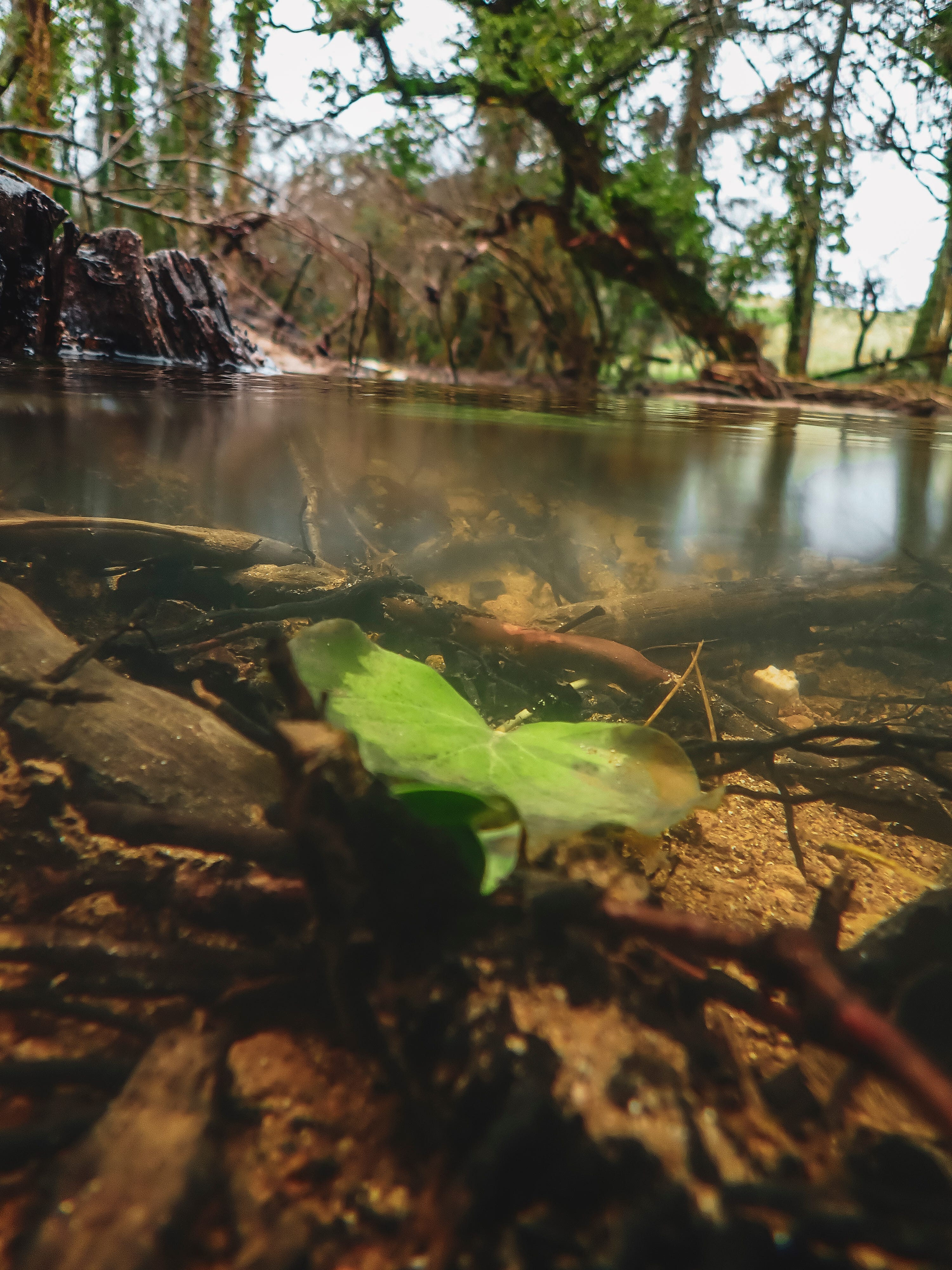
Visuals by Jasper Abel.
biogenesis
/ˌbʌɪə(ʊ)ˈdʒɛnɪsɪs/
noun
the production of life from already-living matter or organisms
There was once an ancient story, about the vital power of trees.
For the best part of my fifteen-year career in nature conservation, I have focused on fighting to return trees, forests and wetlands to our landscapes. Eight of those years have been spent restoring Temperate Rainforests and witnessing the rediscovery of Britain as a ‘Rainforest Nation’. A movement in large part inspired by Guy Shrubsole’s work, ‘The Lost Rainforests of Britain’, published in 2022. A movement that remains in constant evolution.
The last four years of my career have focused on defining the trajectory of that evolution in Devon and Cornwall, and reconnecting people with their lost rainforest landscape. In recent years, Temperate Rainforests have been pulled into focus by expert eNGOs such as ‘Plantlife’, for their immense biodiversity value. Britain’s rainforests are home to over two thousand species of lichen, and over a thousand species of bryophyte. The UK is an international biodiversity hotspot for these ‘epiphyte’ species. Despite being one of the most nature denuded nations on earth and having seen over 90% of our Temperate Rainforests decimated by farming, mining and forestry in the last five thousand years. Temperate Rainforests once covered 20% of the UK, predominantly located on the west coast. This today remains our ‘hygrothermy’, or rainforest zone, where these forests could once again thrive and function.
However, it is here we encounter a foundational, unaddressed tension. Conservation has defined the nature recovery movement in Britain in the post-war period. It has focused on species-led conservation, attempting to reactively arrest declines in species and habitats set in motion centuries ago by industrialisation and deforestation. Often through strict, regressive policy protections designed to freeze land in an undynamic stasis. A focus on the physical. Outcome driven. A framing the psychologist Ian McGilstrist attributes to the left-brain hemisphere. Controlling, reductive and linear. The UK nature restoration sector is inherently conservative, with an entrenched culture around which even progressives coalesce without challenge.
This has often stemmed from the unusual density of siloed, narrow-focus individuals and NGOs that the UK is home to. Compared globally, the number of conservation NGOs in Britain is astonishing and unparalleled. We have hundreds, if not thousands of single-issue charities ranging from an emphasis on mammals, butterflies, invertebrates, trees, rivers, cetaceans, crustaceans to even red squirrels. This is a product of the Victorian period, which created a culture of unprecedented dissection, reduction and categorisation. Inequality creates separation and silo, as wealthy individuals choose to focus immense resources on personally directed philanthropy. In other nations around the world, eNGOs tend to be few, and have a far more holistic, ecosystem restoration focus. Thinking in systems. The answer to this not a single, homogeneous organisation for nature. The vibrancy and diversity of our eNGO sector should be the envy of the world. We must develop connectivity and coordination between these many organisations to avoid that which the writer Joycelyn Longdon describes as ‘islands of isolation’ and create an ‘archipelago of connection’. Systemically drawing on the resilience and ingenuity, while circumventing the division.
I strongly believe this first wave of UK environmentalism has failed. It is fundamentally flawed. While biodiversity is a key indicator of ecosystem health, our focus on biodiversity metrics as an outcome, driving our actions and policies, is restraining us from entering the second, vital phase of the nature recovery movement. Restoration. This movement would instead widen its focus to balanced processes, restoring critical mass levels of rewetted, dynamic and complex wooded habitats at ‘catchment’ scales. Creating a renewed emphasis on keystone, ecosystem engineer species such as beaver, large herbivores and Atlantic salmon. Moving from the physical to the functional. From outcome to process. From the individual to the interconnected.
This second wave approach was initially attempted by the fledgling ‘Rewilding’ movement of the 2010s, spearheaded by writers such as George Monbiot in his work, ‘Feral’. A decade later this movement’s attempt to refocus our efforts on dynamic systems restoration and keystone species has again become mired in the sleepwalk back to a focus on individual species outcomes. What it failed to incorporate, was water. The key element which facilitates the hidden, vital transfers creating living systems which produce abundant, self-sustaining ecosystems. The inter-connective forces I refer to as Dark Nature.
The main issue with Conservation in principle is that it is highly siloed, focused only on the site scale, and ignores ‘shifting baseline’, the denuded state in which these species are surviving, despite, not due to the condition of the ecosystem. It also ignores the fact that the target habitats which a species-led focus desires are anthropogenic, decomplexified, and the remnants of a subsistence farming system. A systemic state of ecological collapse.
We are one of the most drained and deforested nations on earth. Between 1840 and 1880 we drained an area of land the size of Dartmoor every single year in the UK. A similar scale effort was undertaken in the 1970s. We have also destroyed over 90% of our forests. The land has been physically divided with fences, restricting the dynamic flow of ecological drivers such as large herbivores. Key stone species supporting landscape functional balance have been made extinct. Species surviving in this denuded landscape are not reflective of the complex, functional, wet habitats of pre-industrialisation. Unless we shift our focus from a handful of rare and disparate species, we will not be able to undergo the mass scale rewetting and reforestation required to restore our functional ecosystems. We must create a system that restores bio-abundance, not just biodiversity.
Nature recovery must operate within the context of systems. We must recognise the depth to which our ecosystems have collapsed. How they have been separated and siloed, the vital flows blocked and unbalanced. Remaining species and habitats we perceive as rare, and therefore of greatest value, must not become barriers to the restoration of a living ecosystem.
Within this framing, what does a rainforest movement look like that does not focus just on individual rare species, but considers restoration of whole ecosystems? In 2022 I travelled on a self-directed study tour to the Pacific Northwest (PNW) of the US and Canada. These are our Temperate Rainforest cousins, members of a biome which covers only 1% of the planet globally. Other rainforest nations include Japan, New Zealand, Chile and Norway. These rare, ‘goldilocks’ zones often sit at the end of oceanic currents like the Gulf stream and Kuroshio current (the Black stream). These bring stable temperatures to higher latitudes of between one and fifteen degrees celsius, and over one and a half meters of rainfall, spread across two hundred days of a year. Temperate Rainforests are forged by the sea. They are the places in our world where the flow and intersection of water is highest and most powerful. So too are the flows of nutrients. During my visit I spent time with eNGOs such as ReddFish Restoration, who base their environmental restoration approach on the knowledge and wisdom of the Nuu-chah-nulth first nation. A deeply co-evolved culture, who have subsisted in the rainforests of Vancouver Island for tens of thousands of years.
My goal was to learn how these rainforest stewards view, restore and protect their environment. The Nuu-chah-nulth identify as the ‘Salmon-Cedar’ people. It occurred to me most that all the environmentalists of the PNW viewed their rainforests through the lens of the trees, but also most importantly the water and the salmon. There was no siloing present in their restoration approach, but a focus on balance, flow, transfer and reciprocity. Particularly impactful was their view of the forest and sea as interconnected. Viewed and managed as one. If you were to analyse the wood of a tree on the riverbanks of a healthy old growth forest in the PNW, twenty-five percent of the nitrogen and other key nutrients will be derived from the ocean. Millions of salmon return to the PNW each year, bringing nutrients in their bodies from their rich feeding waters in the deep ocean, feeding the forests mycelial networks in their river spawning grounds when they die. Some studies have even demonstrated a direct correlation between the growth rings of trees, and the size of the corresponding annual salmon runs. Trees eat fish.
This was not just the case for fish, but for sea birds also. While on the island, I had the privilege of learning from legendary Canadian forest ecologist, Barb Beasley. Barb spent her early career climbing the previously unmapped and unexplored canopies of giant redwoods on the island. It was her discovery that a small seabird, the Marbled Murrelet, nested in these trees, that allowed their ocean legal protection to safeguard the 10% of old growth forest on Vancouver Island that currently remains unlogged. In other parts of the world such as Palmyra Atoll in Polynesia, red-footed booby birds have been shown to influence the size of manta ray populations, through a multi-species nutrient link. In the UK our ocean forest bird proxy was the White-Tailed Sea Eagle. Lost to human persecution, this bird is slowly returning. Seaweed, fish and even octopus’ carcass have been found in their tree nests in the forests of Scotland.
Despite the millions of returning salmon each year, the PNW is now seeing catastrophic declines in populations. This is thought to be due to the rampant deforestation and draining akin to that which Britain underwent centuries earlier. I asked ReddFish Restoration to point me in the direction of a river which was not witnessing salmon declines, a proxy for restoration we could aim for here in the UK. They directed me to ‘Lost Shoe Creek’, a forested river valley not indifferent in scale to those found on the coasts of my Cornwall home. From the beach where the creek entered the ocean, to the headwaters several miles upstream, I could not see the river. It was completely abundant with over 200m3 per hectare of deadwood. Fallen naturally into the watercourse over thousands of years of protection from human clearance. This place was a revelation. In the UK most of our forests have less than 5m3 per hectare, and half have none. Two thirds of woodland species depend on deadwood. Our rivers have been entirely cleared. Lost shoe creek intuitively demonstrated the ecological and functional layer we have lost. Essential for stabilising water temperature and Ph, regulating flows through the catchment, reducing downstream sedimentation, providing habitat, cover and food for fish. In a healthy old growth forest 10 grams of invertebrates fall on a 1m2 area of river from deadwood each day. Remarkable still was the miles of sea grass and kelp forest which flowed seamlessly from each river mouth into the ocean. These provide multiple years of nursery habitat to salmon, giving them the best chance at survival and growth before heading into the deep oceans. The marine ecologist, Dr. Ian Hendy, describes this matrix of forest, seagrass and kelp, as ‘essential fish habitat’. These are vital for providing nurseries of abundance to ocean species. He also points to the overlooked and vital, ‘intertidal oak habitats’. Where the forests meet the ocean. Once abundant but extensively destroyed. Devon and Cornwall have over 75% of the remaining cover of this rare habitat. He describes sharks swimming two miles up forested creeks on the Ilse of Wight, and crabs living inside the fallen branches of oaks.
Salmon are a forest creature, but they need all of the connected habitats within the whole ecosystem in a healthy state to thrive. Deep ocean, near-shore, estuary, river and forest. Even peatland. In addition to deforestation, we have lost 80% of our kelp and seagrass habitats in the UK. It is no wonder then that our Salmon populations in Britain, which were once so abundant people were paid in them as currency, have almost completely collapsed. There are even theories that tree diseases such as acute and chronic oak decline, may be due to malnourishment. Our forest soils denuded of the abundance the swollen salmon runs once bought to our subterranean mycelial networks.
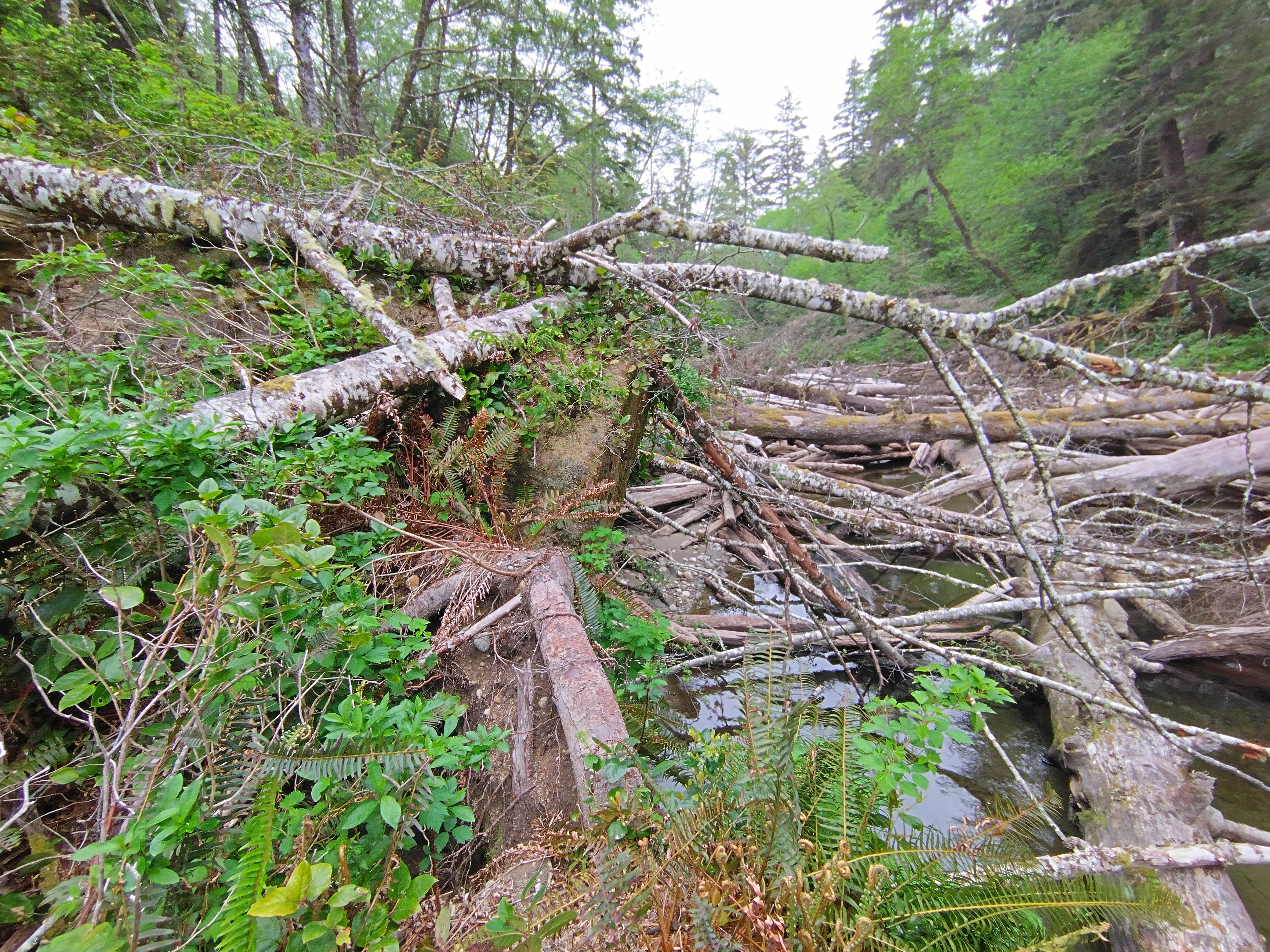
Photo: Lost Shoe Creek
My time in the PNW taught me that oceans and forests are deeply interconnected, and that nature is an emergent property of the collective functionality of ecosystems. This new perspective provided me with a vision for how our rainforest landscape could be returned to vibrant, abundant functionality once again. I looked further, my search taking me to the deep cultural and scientific knowledge and wisdom of Japan, another rainforest nation. I found numerous scientific papers about the connections between forests and oceans. This included multiple books, published only in Japanese. Never making their way to the academic circles of the anglosphere. My mission became to buy numerous books from Japan on this expansive subject and crudely translate them with AI. An endeavour which took months. This further highlighted a key relationship that seemed absent from the environmental debate in the English-speaking world. In 2023, I discovered a particularly striking text titled, ‘If the forest dies, the sea dies’. Written by Dr. Katsuhiko Matusunaga, a marine chemist from Hokkaido University. Matsunaga’s central, fascinating thesis, was that fulvic acid produced by forests, made iron transported in rivers to the sea, bioavailable to ocean plankton. Plankton biomass has declined by 50% globally since 1960. They produce half of our global oxygen and sequester a third of our carbon emissions. Their decline has been attributed solely to climate change related issues such as ocean acidification. Matsunaga suggests that a blind spot, a hidden factor the environmental movement has missed in explaining this decline, is deforestation. We have deforested a third of our planets forest cover. In Japan, the average forest cover is 68%. In the UK it is 13.6%. In Cornwall, it is as low as 8%. Studies have shown in the highly forested Japanese river catchments bioavailable iron is up to ten times higher in their estuaries compared with agriculturally dominated ones. Fish biodiversity is also far higher. Matsunaga also described a phenomenon called ‘Isoyake’, or ‘ocean desertification’. Occurring when forests are lost and land water flows lose the abundance and chemical balance they provide. Ocean kelp forests are lost and replaced by a crust of ‘calcareous algae’, unable to reestablish their root like fronds to the coast’s rocky habitats. Marine biologists are now beginning to recognise that our marine ecosystem may be in the same state of collapse, of desertification. Restoring complex, vegetative habitats like kelp forest to our seas will require seismic restoration efforts. Restabilising water flows with forests, and reintroducing boulder habitats to our pulverised sea floors.
This research changed the way I saw the natural world forever. Further exploration bought my attention to a political movement that had occurred in Japan in the 1990s, inspired by this science. The ‘Uotsukirin Roh’, or ‘Fish Forest’ movement, was led by fisherman Shigeatsu Hatakeyama, a legendary environmental figure in Japan referred to affectionately as ‘Grandpa Oyster’. He started an eNGO called ‘The forest is longing for the sea; the sea is longing for the forest’. Painting a picture of the ocean and forest as lovers, deeply interdependent. He led a movement of fisherman who banded together, bought land and planted trees. Driven by their deep cultural and scientific understanding of the importance of trees to their livelihoods. In Japan there is an ancient proverb in Japan. If you want to catch a fish, plant a tree.
‘Fish Forests’, are a literal legal designation as well as an ancient cultural phenomenon in Japan. There are over 1000 sites, covering more than 60,000 hectares. Unlike our legally protected sites such as SSSIs (Sites of Special Scientific Interest); Fish Forests are protected not for what lies within them, but what they provide, at scale and in critical mass collective to the wider ecosystem. To the hydrological catchment. From the highest headwaters to the deep oceans. This policy system values trees above all other land metrics. Trees are favoured least in our siloed system. Thomas Talhelm uses the analogy of rice farming systems, based on water flow and therefore producing more collectivist social organisation in the landscape seen in south-east Asian cultures. In opposition to the wheat-based farming systems of the west, which produce siloing, commodification and lack of connectivity. In flow systems, land management is highly connected.
In his seminal work, ‘Is a river alive?’, by Robert Macfarlane, he describes the work of Arthur Strahler. He creates the image of hydrological river catchments as single living systems, like trees. The main river, the trunk. The tributaries, the branches. The forests, the leaves. In this analogy, forests are merely fragments of this system, not systems themselves.
To take this analogy one step further, the ocean is the soil. Salmon, which forage and return nutrients from the deep ocean are its roots and mycelium. Feeding the land. The land feeding the ocean. Xylem and phloem on a planetary scale. This dark nature, the scales in between have no language, or terminology. We understand a living system at our scale, a tree. We are beginning to understand the planetary scale, Gaia. But what about these river catchment-scale trees, and their associated ocean soils? I refer to these as Flowscapes.
Flowscape provides a mental framework to imagine a system at a greater scale, to unite ocean and forest in one system. To see the environment as it functions, as flow not form. Producing nature as an emergent property of balanced process and mutual transaction. I orientate myself in the landscape and in the environment by which Flowscape I am located within. The Dart, the Fal, the Thames. A great organism. In addition to Fish Forests, which are site scale. There is a term for Flowscape in Japanese. ‘Kyodai’, which translates to ‘Siblings’, or ‘Great Heroic Brotherhood’. The unity of these two ecosystems producing planetary scale nature. Landscape, seascape and even ‘wholescape’ are inadequate terms. They are not alive or flowing. There are dead landscapes on Mars.
These concepts provide us with a narrative, policy and scientific framework to steer our dying Flowscapes back to abundance and functionality. If we can create a system which facilitates the critical mass restoration of ‘Biogenic’ forest habitats. Rewetted, hydrologically restored, complex woody habitats, particularly in our uplands, where farmland is least productive. Abundant with ecological driver species creating structural and functional dynamism, such as beavers and even water buffalo. The engines of life. ‘Biogenesis’, describes the work of keystone engineer species such as the willow tree. A species selectively removed from our river systems in favour of timber crops. This species is essential for reversing the drainage, and artificial straightening of our rivers. In many of the woods I manage, willow represents less than 10% of our river woodlands, a deeply unnatural state. Willow should be hyper abundant. (Siloed, scarcity valuing traditional conservation misguidedly views these and almost all other tree species as the enemies of biodiversity). We have altered almost every inch of watercourse in Britain. Destroying biogenesis. Our landscape is riddled with a lattice of sub-surface drainage pipes, stenting water under our feet. Plastic pipes four feet down. Clay pipes eight feet down. Square slate drains over one thousand years old up to ten feet underground. Draining our Flowscapes of water and life, unable to regulate the ever more extreme flooding and drought that climate breakdown wreaks upon us. Researchers are beginning to develop AI learning models based on LiDAR, which may soon reveal the breathtaking extent of this hidden underground network of drains. Turning the landscape against us under of feet.
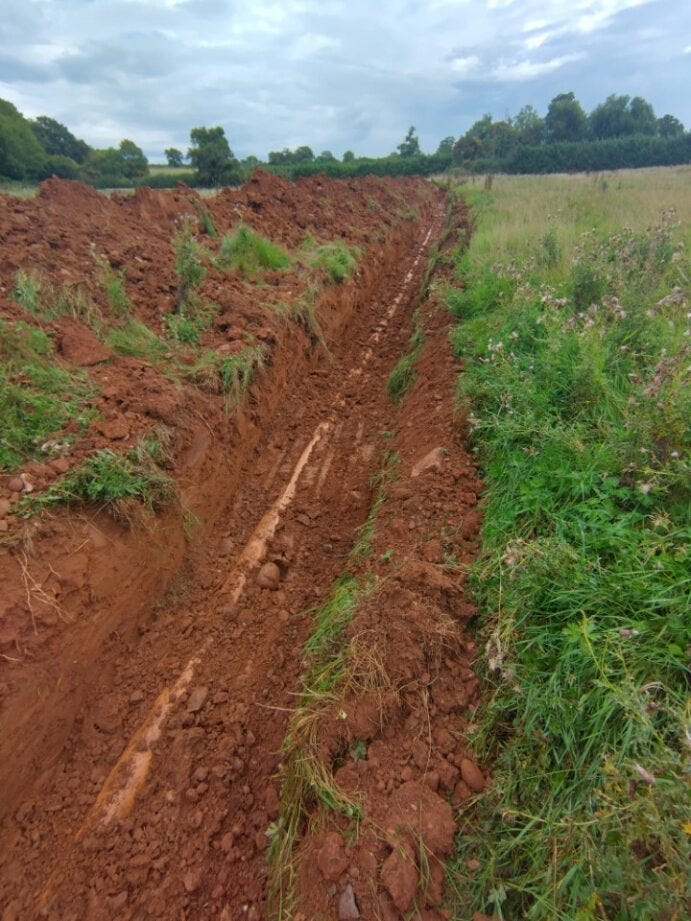
Photo: A hidden underground drainage pipe in Devon.
Almost any ‘incised’ watercourse; drainage ditches, straightened streams, exist in this state only due to human removal of biogenic features. Deadwood, willow, beavers. Life which engineers living systems by capturing water. If returned, these water systems turn back on, come back to life in astonishing ways, and begin to contribute to the Flowscape, the wider system. This is essential for stabilising and slowing water flows through our Flowscapes. Protecting communities, farming, ecology and oceans. In Devon and Cornwall, communities are already at the mercy of increasingly intense rainfall events. Towns on the frontline of a changing climate, like Totnes, Lostwithiel and Helston already flood multiple times a winter. We are due to experience 50% more rainfall in peak events by 2060 in this region, making any engineered approach to flood management impossible to scale. By deforesting our biogenic landscape, we have ripped the roof of our house, and there is a storm coming. UK farming suffers productivity losses of £1.2 billion per year to soil loss, from rainfall run-off. By 2060 we may have so little topsoil left that farming will be unviable. This issue extends to sewage overflows, which plague our rivers and seas. Nature-based solutions like restoring biogenesis in the upper catchments can reduce the pressure on our crumbling combined sewage overflow systems. Coupled with a reduction in sedimentation and soil loss, this will assist vital seagrass and kelp restoration projects at sea, which are routinely being destroyed by smothering overflow events. Biogenic forests, seagrass and kelp must be restored together.
In 2024 I commissioned an independent bibliography called, ‘the environmental connections between oceans and forests’. This sought to throw a net around all the research globally that studied this interaction. When the author Dr. Ben Phillips began the research process, he suggested he had limited confidence in finding results. Citing this was not a concept he was familiar with, its scope too non-linear to be empirical. Six months later, his opinion had radically changed. He intimated this may be an entirely new way of framing scientific research, a new frontier of systems ecology. The bibliography found 276 papers which reinforced the connections made by Matsunaga and Hatakeyama. Scientifically validated the ancient ecological wisdom of cultures such as the Nuu-chah-nulth. It also reflected my assumption, most research hailing from Japan and the PNW, Europe almost devoid of research on the subject. Research continues with a funded desk study, modelling correlations between existing forest cover data in the UK, with marine invertebrate, fish and plankton datasets. The research is still to be finalised, yet already it is reinforcing the thesis, but with a potentially horrifying revelation. Unlike the systemic function found in the highly forested Flowscapes of Japan. Ours have ceased to function, our living systems grinding to a halt. Stripped of biogenesis.
In Matsunaga’s book. He tells the story of Cape Erimo, Hokkaido, the northern island of Japan. A Temperate Rainforest. Once entirely forested, with abundant fish stocks. Home to the Ainu first nations who held deep knowledge of salmon, water and forests. Their reciprocity and interconnection. At the beginning of the 20th Century the cape was deforested for mining, farming and logging. Within a few years the soil had been lost, the land denuded and the oceans fish stocks collapsed. In 1950 the local community began restoring the lands soils and forests through a process called the ‘Goda Method’. By hand people bought seaweed and kelp from the nearby oceans and used it to rebuild topsoil structure and create a substrate for trees and seeds. By 1995 the cape had been drastically reforested, and fish stocks had rebounded by twenty times. A radical and astonishing rate of critical mass Flowscape restoration, a blueprint for what could be possible here. In places such as Cornwall, where our historic fishing industry is on the brink of collapse.
The blueprint is already taking form. In Devon and Cornwall biogenesis is already returning to the land. On Exmoor, where pioneering ecologist Ben Eardley has ‘reset’ an incised, degraded river system using the ‘Stage Zero’ method. Reintroducing 800m3 of deadwood and living willow to the channel, emulating natural watercourses like Lost Shoe Creek. As he describes, ‘control, alt, deleting’, the human made drainage channel and bursting back into life, a ‘riverscape’. Freeing the water onto the land. Transforming a dry, degraded field into a regenerated system of life, buzzing and vibrating with species and function. Multiple, diverse braided channels and a dizzying myriad of habitat niches, and clear, cool water. In South Devon, this has inspired my own work, restoring multiple tributaries to a biogenic state, with stage zero restoration, leaky dams, ‘beaver dam analogues’ or flow deflectors, and willow. In 2025 we re-flooded a three-hectare forest, freeing an imprisoned river channel from its anthropogenic state of incision and embankment, bursting it back to life and balance. This human degraded brook, like most watercourses in Britain formerly ran like a brown firehouse of pollution in winter, and sat dry in summer. Biogensis has stabilised its flow, filtered its water and boosted its habitat quality. My growing aspiration has sights set on the next prize, a thirty-five-hectare forest floodplain reconnection project in Cornwall. If successful this could turn the tide on protecting the downstream community from flooding, reducing sewage overflows and aiding marine ecosystem recovery. Biogenesis is scalable.
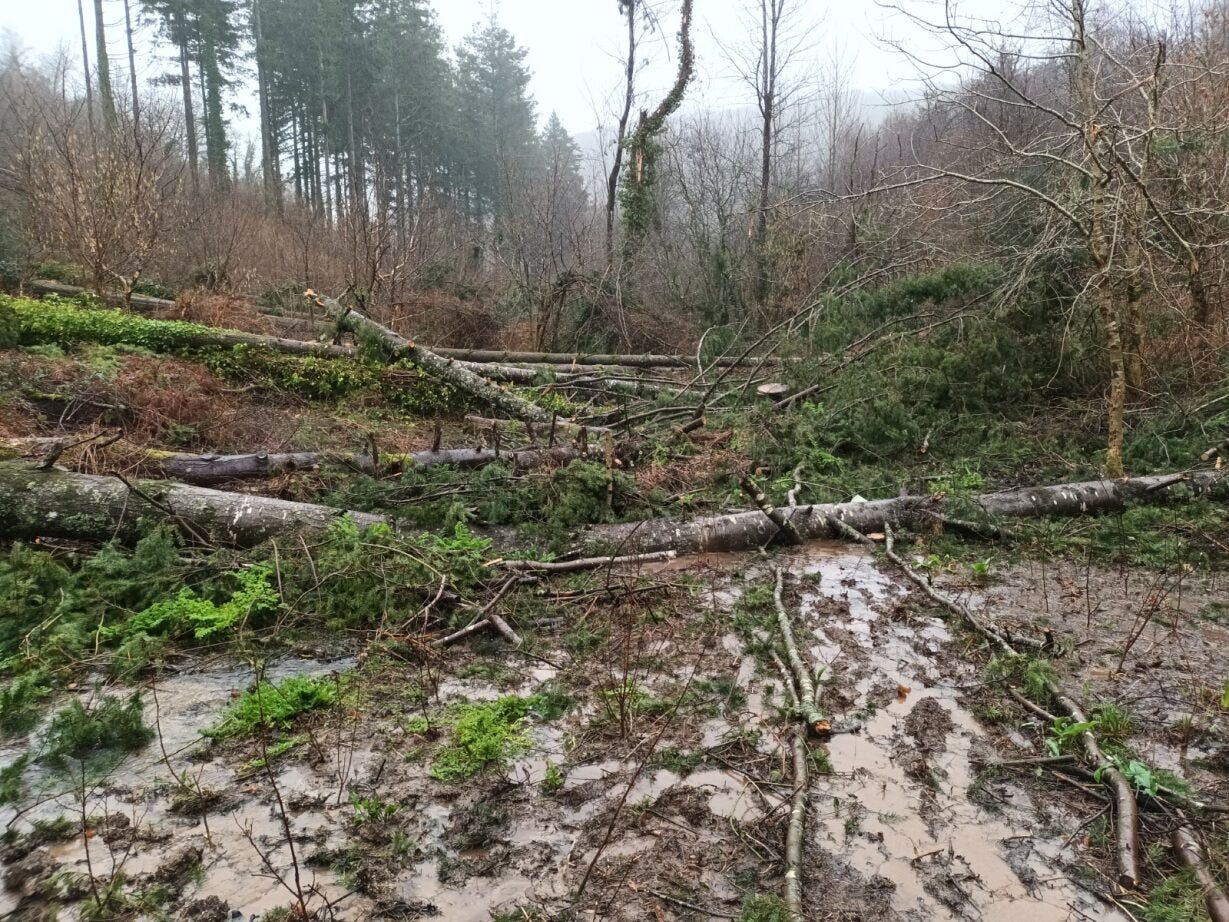
Photo: Stage zero biogenic forest restoration in Devon. Featuring ‘beaver dam analogues’ (flow deflectors) and newly planted willow trees.
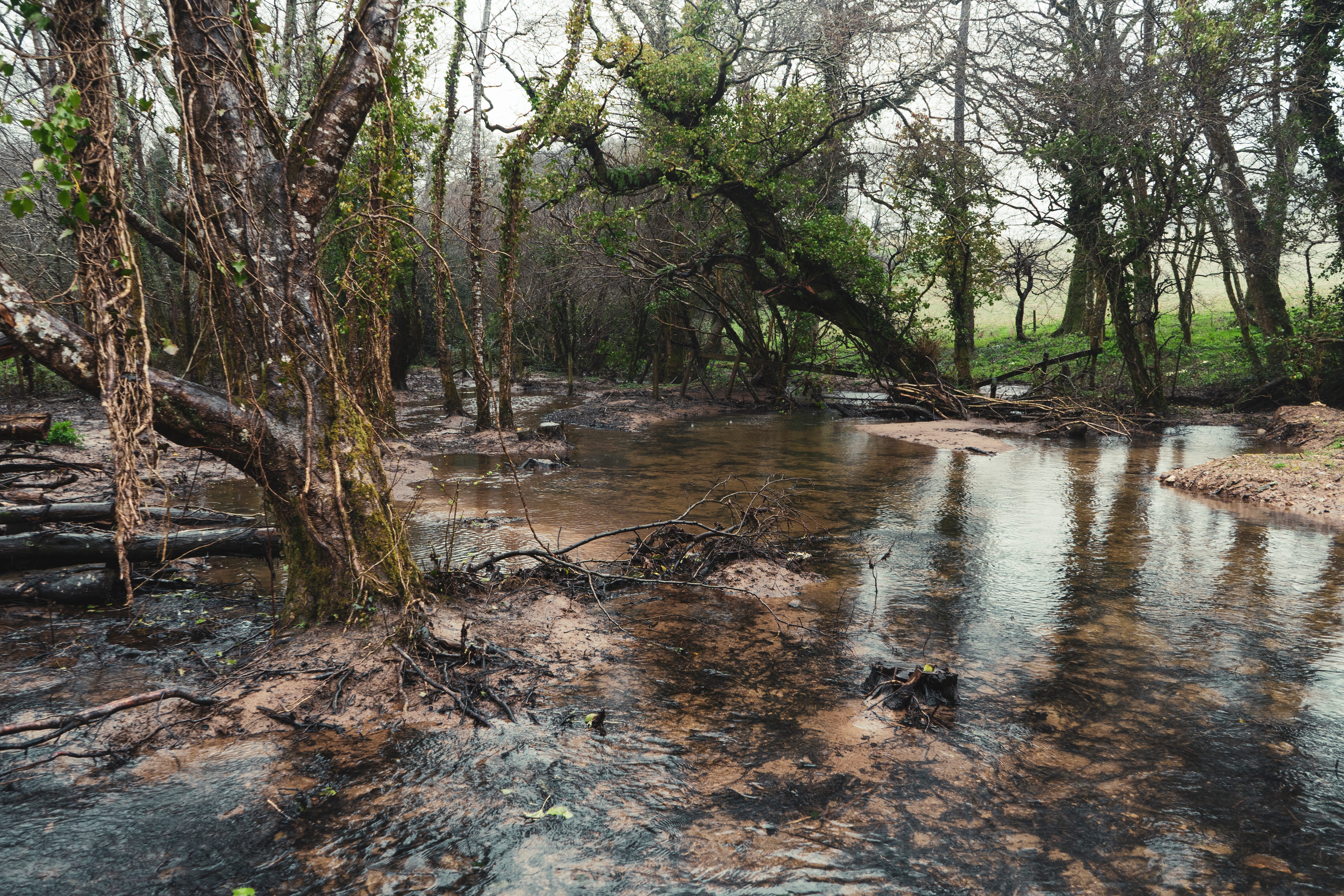
Photo: Reflooded forest in Devon (Jasper Abel)
In the UK, farmland covers 70% of our land. Of this, 50% produces only 20% of our farming output, and 20% only produces 2% of our output. Most of this lies in the west, the rainforest zone. In the Brazilian rainforest, a molecule of water travels through a tree five times on its journey from the Atlantic Ocean to the centre of the Amazon basin. Transpired again and again in a conveyor belt of biotic tree pumps. This phenomenon once occurred in Britain when 20% of our land was covered in biogenic rainforest, reducing flooding in winter, and releasing vital stored rain on the prevailing southwesterlies to the east in summer droughts. Rainforests also produce cloud forming aerosoles called terpenes. ‘Cloud condensing nuclei’. Forests are keystone rain engineers. I have witnessed this for myself in the Dart valley on Dartmoor, where the last remaining major fragment of rainforest in Devon produced a localised thunderstorm, during a thirty-degree drought in mid-summer. Scientific modelling from researchers at Plymouth University suggests critical mass reforestation of our rainforest zone could restore this biotic pump effect. Producing more rain in key summer months. Protecting the more productive 50% of farmland in the rich soils of the South-east, which are due to experience 90 days of soil drought, and two weeks of forty degree heat every year by 2060. When we think at a systems scale, the framing of the food security debate changes entirely.
The UK is one of the most deforested countries on earth. The UK government has committed to legally binding targets which aim to increase forest cover by 3% by 2050. This would result in a 16.5% cover UK wide, and a 12% cover in regions like Cornwall. Despite this meagre ambition, we are still only achieving 48% of our woodland creation targets.
We are facing a cultural crisis. An anti-tree syndrome. A Treespiracy. There are three main barriers to woodland creation in the UK. One, is economics; as it stands funding for tree planting is highly generous but still falls short of balancing out the loss of land value caused by converting farmland to woodland. This is a symptom of a system that does not value trees and forests correctly. Two, is landowner interest; the UK landscape is dominated by private ownership, meaning a mass reforestation effort rests on the whim of a small minority of the landowning class. Without a new cultural story, and a groundswell of support for trees, landowners will not be sufficiently inspired to embrace biogenesis. Three; regulatory barriers. In our current system of traditional conservation, hyper-conservative regulatory bodies such as the National Landscapes, National Parks and Natural England are the gatekeepers of a landscape held in stasis. They value landscape character, heritage, archaeology and a handful of rare remnant species over progressive, restoration of biogenic systems. They are designed to oppose restoration. Defining their landscape design on replicating an idealised past aesthetic, not serving a future vision of a functioning ecosystem that provides abundance for present and future generations. Thousands of hectares of woodland creation are being blocked each year, behind closed doors, by a handful of individuals who are anonymous, unaccountable and unelected. Ecosystems in their true form are messy, dynamic and alive. Balanced in chaos. Our landscapes are locked in a tidy, moribund stasis. In Cornwall large areas of soil and water are polluted with heavy metals from the now defunct mines of the industrial revolution. Research by forests ecologists such as Lou Astbury, founder of ‘From Trees’ demonstrates that trees such as willow, are powerful bio remediators of heavy metals and toxins from soils. Her work emulating the Japanese ‘Goda’ method of soil restoration with seaweed also offers hope for the obliterated landscapes of Cornwall and beyond. Denuded landscapes which our current system views as optimal and desirable, to be protected at all costs from the return of true nature. Our policies and frameworks are focused on landscape aesthetic, heritage and rare species. Neither serve to protect us from or, or will likely survive the impacts of a changing climate. If our bias towards conserving aesthetic landscape character is not constructively challenged, and we cannot move to a system that facilitates biogenic reforestation, we will never again see clean, healthy soil and water, or biodiversity return to our uplands, coastlines, rivers and seas.
To meet our planting targets, we need a powerful new story about the value of trees and biogenic forests. We also need to be more ambitious, aiming for 25% forest cover by 2050, if we are to have any hope of restoring living Flowscapes. Trees are so much more than individual metrics like the timber and carbon we see them as. They are the keystones around which our entire living ecosystems, both marine and terrestrial, form and function.
When we think in systems, in flow, in biogenesis; trees ascend from the least, to the most valued beings in our natural world. We need to ask ourselves a question. Can we do this better? I believe the answer is yes. I believe the way we do that is to stop siloing, and focus more on water, trees and keystone species.