
NO TREES, NO SEAS.
Are we missing a hidden connection between oceans and forests?

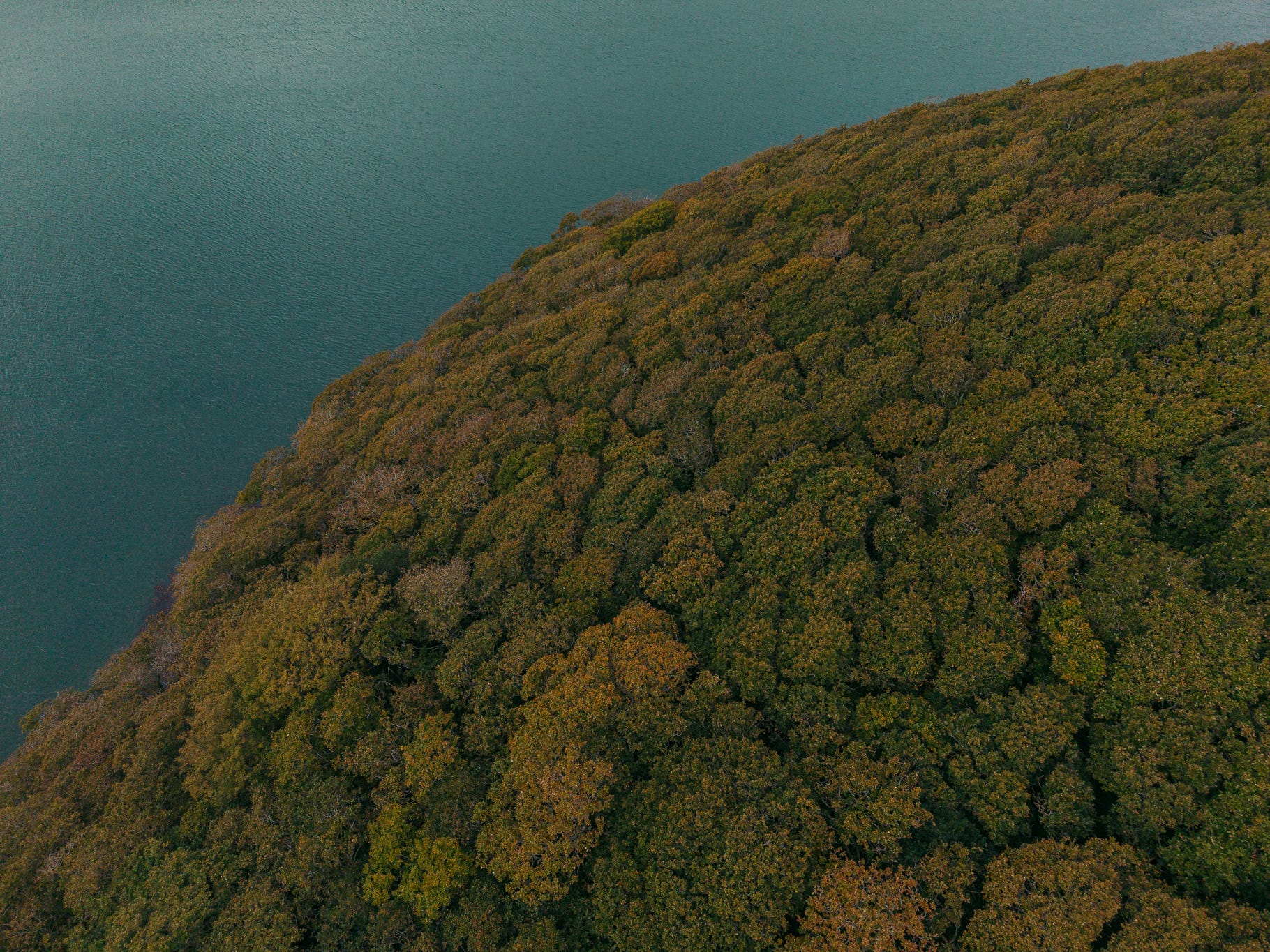
Visuals: James Bowden
Originally published in Marine Biologist Magazine, January 2026
A lone, diminutive oak sapling shivers in the south-westerly, malnourished in the thin, exposed soils of the post-mining landscape so familiar to Cornwall’s north coast. These valleys were once adorned with a landscape of Temperate Rainforest, 90% of which has been lost to centuries of metal and peat extraction, Kernow’s klondike. This blasted, open landscape of heathland is now a shifted baseline, considered emblematic of Cornwall’s character and identity, much like the marine ecosystems for which it is cherished. However, new research may be suggesting that without the return of Britain’s forests, our seas may never recover from their increasingly denuded state.
A neglected relationship?
In 2025 the Woodland Trust published, ‘Environmental Links Between Oceans and Forests’, a bibliography by Dr Benjamin Phillips consolidating global research on the chemical and biological connections between these two ecosystems. In many cases the research treads old, well studied territory, such as ocean surface temperature predicting inland forest growth and forest fire intensity. Forest fires triggering mass plankton blooms and subsequent negative carbon sequestration feedback loops. Or that over 25% of nutrient inputs into Canadian old growth forests are derived from Salmon returning from the ocean. However, the publication also begins to shed light on a potentially astonishing relationship between forests and the sea. In Japan, which boasts 68% forest cover in stark contrast to the UK’s naked 13.6%, and where historically sea food, ranging from oysters to seaweeds have formed an integral part of the nations diet, new science is showing that the numbers of trees on land, may be a limiting factor to the number of fish in the ocean.
One study suggests that fulvic acids derived from forest soils, are essential for increasing the amount of bioavailable iron in estuaries and can be up to 10 times higher in the coastal vicinities of river catchments with relatively higher forest cover. This correlates with higher plankton biomass, which require bioavailable iron to absorb phosphates and other critical nutrients. Plankton underpin the oceans food webs, are a titanic carbon store and produce half the world’s oxygen. Another paper which studied 22 different Japanese estuaries suggested catchments with higher forest cover (particularly those higher than 75%), had above average numbers of red list data fish species. Sea birds are too revealed to be a vital part of this systemic ecosystem exchange, in a study of the Palmyra atoll, plankton and manta ray populations were found to be dependent on ‘seabird vectored nutrient inputs’, or guano, from species such as white-tern and red-footed boobies.
The bibliography only identified 270 papers globally, with the majority originating in North America and Asia, highlighting the distinct lack of research in this field, but illuminating a potential new scientific frontier for how we can understand earth’s natural ecosystems, and approach their restoration.
In Cornwall, this research is inspiring a wave of activism and renewed focus on forest restoration. The ‘No Trees, No Seas’ campaign, a grassroots environmental coalition led by PlantOne Cornwall, is drawing parallels between the 90% loss of forest cover, and the ~80% loss of vital vegetative marine habitats such as seagrass. Their message is simple; To save our seas, we need more trees. No Trees, No Seas is attempting to create a unified vision for the restoration of Cornwall’s damaged environment, one based around the idea of the ‘Flowscape’, the interconnected system of chemical exchange between forest catchments and sea, that has been broken by human activity. The campaign claims that by restoring forest cover on land, and the ability of these forests to hold and store water, pollutants and sediment run-off can be arrested, supporting the growing restoration of seagrass and kelp habitats in Cornwall’s coastal waters. Salmon populations may also be revived through the restoration of their native forest habitat. The Woodland Trust is also pushing forward with research into this area, studying links in the UK between forest cover and marine datasets such as plankton biomass and fish populations. If a scientific connection can be made here, then the return of our forests that campaigns like No Trees, No Seas are calling for, may be essential in the struggle to revive our collapsing fish stocks and ocean ecosystems.
Cape Erimo, Hokkaido, Japan.
A dense young forest sways in the sea wind. 60 years ago, this landscape resembled that of a modern Cornwall, deforested in the early 20th century for mining, farming and logging. By 1950, the deforestation had led to an almost total collapse of Cape Erimo’s once abundant fish stocks, prompting a radical restoration response. Utilising the ‘Goda method’, locals used seaweed to restore lost soil structure and facilitate mass tree planting to restore the coastal and upper-catchment forests. By 1994, fish landings were up by 20 times their number just 40 years earlier.
Further south, in Kesennuma Bay, a fisherman known affectionately as ‘Grandpa Oyster’, Shigeatsu Hatakeyama was rallying the fishing community and establishing the NGO ‘the forest is longing for the sea, the sea is longing for the forest’. His story of the forest and ocean as lovers, pulled apart by humanity was galvanising action in response to similar collapses in oyster stocks, associated with deforestation in the river catchment above. This led to an alliance of fisherman buying land to reforest, in order to safeguard their livelihoods, a model that could be replicated in the UK.
Science and nature restoration from other nations may be illuminating a path we can follow to restore degraded land and seascapes like those in Britain, that focus on ecosystem functionality and systemic reciprocity.
The No Trees, No Seas campaign plans to call for the creation of the UK’s first ‘Fish Forest’ in 2026, modelled on the Japanese ‘Uotuski-rin’ designated protection (Fish-bearing forest), in which forest catchments are protected, not just for their material value, but for their essential contribution to the functionality of the wider ecosystems, particularly the ocean. Japan has over 1000 such designated sites and has done since at least the 17th century.
In Japan, they have an ancient proverb, ‘If you want to catch a fish, plant a tree’.
Download the ‘Environmental Links Between Oceans and Forests’ bibliography here:
https://www.rainforestrecovery.org.uk/news/oceans-and-fores-a-new-discovery
Learn more about the No Trees, No Seas campaign at https://www.notreesnoseas.com
References
Lavergne, E., Kume, M., Ahn, H., Henmi, Y., Terashima, Y., Ye, F., Kameyama, S., Kai, Y., Kadowaki, K., Kobayashi, S., Yamashita, Y., Kasai, A., 2022. Effects of forest cover on richness of threatened fish species in Japan. Conservation Biology 36, e13847.https://doi.org/10.1111/cobi.13849
Matsunaga, K., Nishioka, J., Kuma, K., Toya, K., Suzuki, Y., 1998. Riverine input of bioavailable iron supporting phytoplankton growth in Kesennuma Bay (Japan). Water Research 32, 3436–3442. https://doi.org/10.1016/S0043-1354(98)00113-4
McCauley, D.J. et al. From wing to wing: the persistence of long ecological interaction chains in less-disturbed ecosystems. Sci. Rep. 2, 409; DOI:10.1038/srep00409 (2012). Shimpei Iwasaki, 2021. Fishers-based forest planting initiatives in Japan: Lessons learned, Regional Studies in Marine Science, Volume 45, 2021, 101839, ISSN 2352-4855, https://doi.org/10.1016/j.rsma.2021.101839. (https://www.sciencedirect.com/science/article/pii/S2352485521002310)
Grandpa Oyster ♥️